


Climate-change adaptation

Adapting your activities to climate change
Droughts, late frosts, excess water… climate hazards are intensifying and destabilizing production systems. Agriculture in northern France is affected just as much as elsewhere.
High-value crops in our regions, present in spring, are particularly vulnerable, putting both farms and processing sectors at risk. Agro-Transfert offers its expertise on climate projections, their impacts on crops, and the levers available to support the necessary adaptations.
Our expertise for your projects
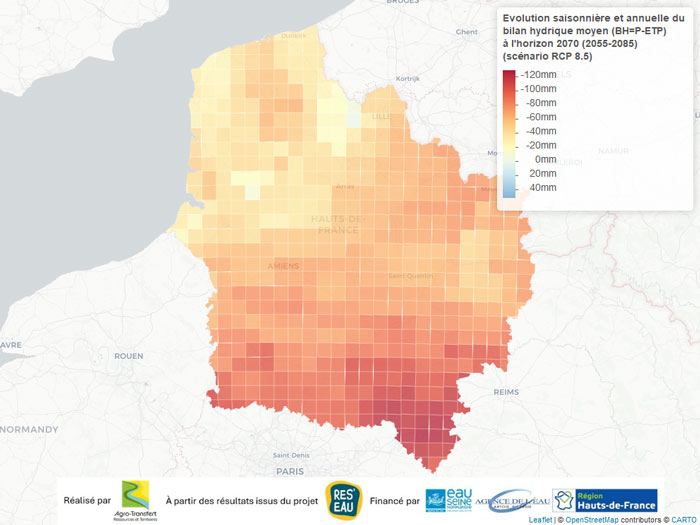
Climate projections are adapted locally to ensure their appropriation.
Local projections to guide decisions
Agriculture in the northern Paris Basin enjoys certain advantages: soils and climate favorable to diversified farming. Adapting farms, territories, and supply chains to climate change is essential to maintain these assets. Agro-Transfert makes the latest climate projections from IPCC scenarios accessible at an 8 x 8 km resolution, aiming to integrate climate considerations into action plans at multiple scales.
Translating IPCC scenarios into crop impacts
We translate IPCC scenarios into impacts on regional crops, working with relevant experts. For example, the Res’eau project focuses on potatoes and peas, iconic crops of the Hauts-de-France region. We also address emerging crops such as sunflower and soybean.
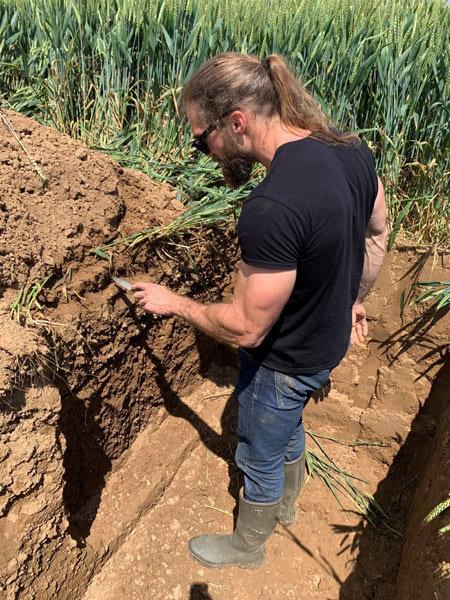
Our experts assess how agronomic levers affect soil water.
© AGT-RT
Levers to secure northern French farming systems
Drought is a major concern for stakeholders in northern France due to high-value summer crops—potatoes, peas, flax… Irrigation demands for these crops are likely to increase, in a context where the Plan Eau aims to reduce withdrawals by 10% across all sectors by 2030. Our work identifies innovative solutions to cope with the increasing frequency and intensity of water stress.
Northern agriculture will also face periods of excess water, with increasing interannual variability in rainfall patterns. Many resilience keys lie in the soil. Practices tested in the Res’eau Expé project aim to infiltrate, store, and retain water in the soil. We benefit from the scientific expertise of Lionel Aletto, INRAE researcher who coordinated similar studies in southern France.

Our work is debated in various forums to contribute to discussions on agricultural adaptation.
© AGT-RT
Supporting adaptation
Adaptation solutions exist. Their deployment requires considering local contexts and reconciling them with other agricultural challenges—carbon storage, weed management, etc. The equation is complex. Our goal is to support advisors, local authorities, and agricultural sector actors through:
- Testing tools and methods (Res’eau, RESYST projects)
- Participating in discussion platforms (e.g., PLOAA, Clim’EauFil)
- Offering expertise, interventions, and training programs
Do you have a project?
Let’s discuss it. Our experts are ready to help you turn ideas into action.
- Aïcha Ronceux, Head of the Climate Change Adaptation Domain – a.ronceux@agro-transfert-rt.org
- Charlotte Journel, Program Manager – c.journel@agro-transfert-rt.org